
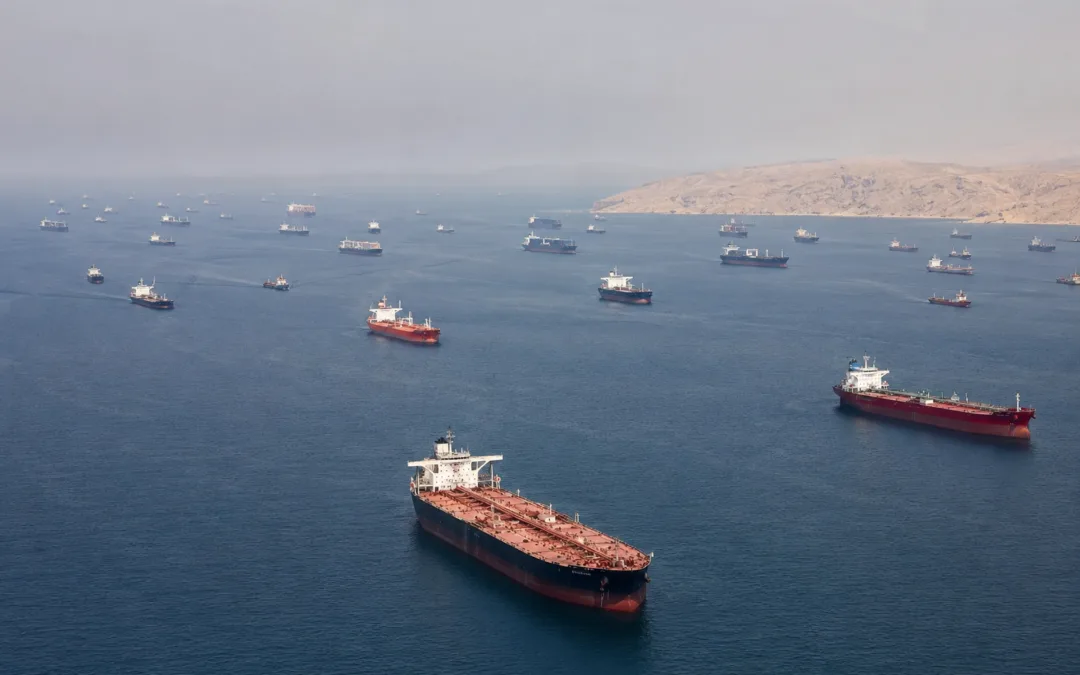
Hormuz crisis and maritime transport. The Strait of Hormuz is one of the most strategically important maritime chokepoints in global trade. Approximately 20% of the world’s oil consumption and nearly 20% of global liquefied natural gas (LNG) trade pass through this narrow waterway every day.
As geopolitical tensions rise in the region, the impact on the maritime industry is immediate. Increased operational costs, higher insurance premiums, and disruptions to global supply chains are just some of the challenges faced by shipowners, operators, and logistics companies.
Why is the strait of Hormuz so important?
The Strait of Hormuz is a critical gateway connecting the Persian Gulf with the Arabian Sea and international shipping routes.
Every day, the strait handles:
- More than 20 million barrels of oil per day.
- Around one-fifth of global LNG exports.
- Thousands of commercial vessels, including tankers, bulk carriers, and container ships.
- Key exports from Saudi Arabia, the United Arab Emirates, Kuwait, Iraq, and Qatar.
As a result, any disruption in this area can have significant consequences for global trade and energy markets.
Hormuz crisis and maritime transport. The immediate economic impact
Whenever there are threats to maritime security in the region, financial markets react quickly.
Recent periods of tension have resulted in:
- Oil price increases of more than 10% within days.
- War-risk insurance premiums rising by 300% to 500% on certain routes.
- Additional security costs ranging from $30,000 to $100,000 per voyage, depending on vessel size and cargo type.
- Significant increases in charter rates for oil and gas carriers.
Consequently, shipping companies face rising operating expenses that ultimately affect the entire supply chain.
Hormuz crisis and maritime transport. How shipping companies are affected
The impact extends far beyond fuel costs.
Shipping operators must also deal with:
- Route diversions to avoid high-risk areas.
- Longer transit times.
- Increased fuel consumption.
- Enhanced security procedures.
- Greater uncertainty in voyage planning.
Furthermore, delays can lead to contractual penalties and financial losses for both carriers and cargo owners.
Hormuz crisis and maritime transport. Challenges for shipowners
Shipowners are facing a combination of operational and financial pressures.
Among the most significant challenges are:
- Increased energy market volatility.
- Higher maintenance costs.
- Greater wear and tear on engines and turbochargers due to longer voyages.
- Reduced predictability of operating expenses.
- Higher demands for fleet availability and reliability.
Therefore, maximizing operational efficiency has become a strategic priority.
The role of maintenance during uncertain times
When operating costs increase, every percentage point of efficiency matters.
A turbocharger operating below optimal performance can lead to:
- Higher fuel consumption.
- Reduced engine power.
- Increased emissions.
- Greater risk of unplanned failures.
- Expensive vessel downtime.
For this reason, many shipping companies are strengthening their preventive maintenance programs and investing in the monitoring of critical equipment.
Preparing for a more demanding environment
Although the future development of the conflict remains uncertain, the maritime sector is already adapting to a more volatile operating environment.
Companies that successfully control operating costs, optimize engine performance, and ensure the reliability of their equipment will be better positioned to navigate the challenges associated with one of the world’s most important shipping routes.
The Strait of Hormuz remains a cornerstone of global maritime trade. Any conflict or disruption in the region has immediate consequences for shipping costs, fuel prices, vessel operations, and international supply chains.
In such an environment, operational efficiency and equipment reliability become critical competitive advantages. Maintaining engines and turbochargers in optimal condition not only improves vessel performance but also helps reduce costs and minimize operational risks during periods of market uncertainty.