
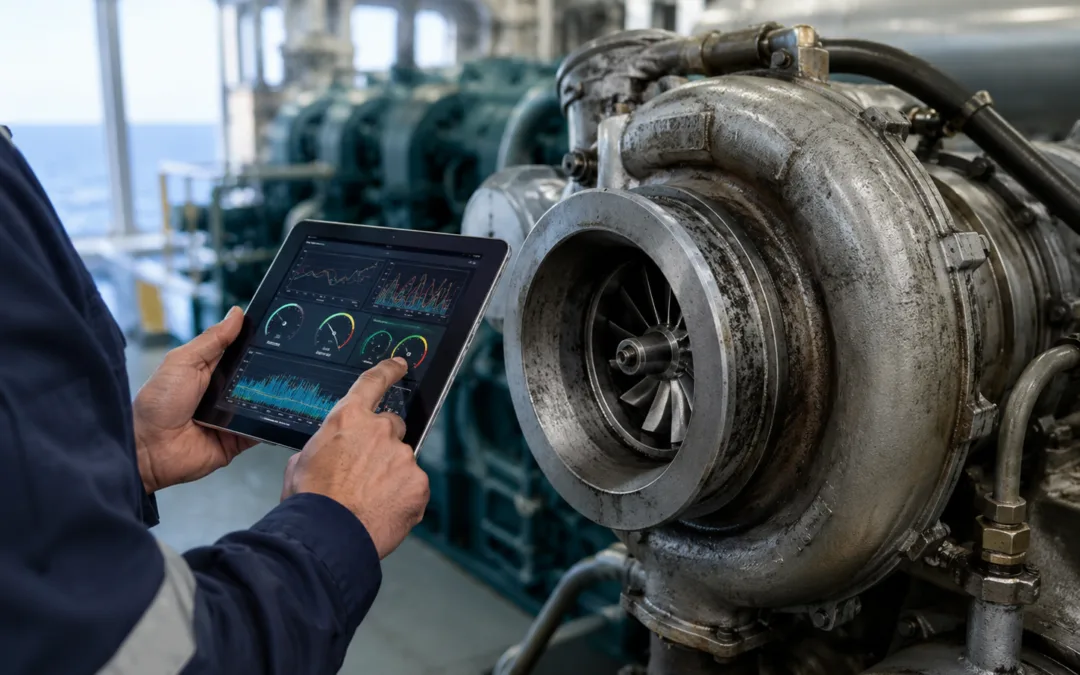
How to detect marine turbocharger performance loss. Marine turbochargers play a critical role in the efficiency, reliability, and performance of modern diesel engines. Whether installed on merchant vessels, offshore platforms, ferries, or tugboats, these components ensure that engines receive the compressed air required for optimal combustion.
However, turbocharger performance does not deteriorate overnight. In most cases, there are early warning signs that indicate a loss of efficiency long before a major failure occurs. Recognizing these indicators can help shipowners, operators, and maintenance teams prevent costly breakdowns, reduce fuel consumption, and extend equipment lifespan.
Why turbocharger performance matters
A marine turbocharger increases the amount of air entering the engine cylinders, allowing more fuel to be burned efficiently. As a result, the engine delivers higher power output while maintaining lower fuel consumption and emissions.
When turbocharger performance begins to decline, the entire engine system is affected. Consequently, fuel efficiency decreases, operating costs increase, and critical engine components may be exposed to additional stress.
For this reason, monitoring turbocharger condition should be an essential part of every vessel’s maintenance strategy.
Key signs of marine turbocharger performance loss
Increased fuel consumption
One of the earliest indicators of turbocharger inefficiency is a noticeable increase in fuel consumption.
If a vessel requires more fuel than usual to maintain the same speed or engine load, the turbocharger may not be supplying sufficient airflow for efficient combustion.
Therefore, tracking fuel consumption trends can provide valuable insight into the health of the turbocharging system.
Reduced boost pressure
Boost pressure is one of the most important operating parameters of a marine turbocharger.
A reduction in boost pressure often indicates problems such as compressor fouling, internal wear, air leaks, or turbine damage. Moreover, lower boost pressure directly impacts engine performance and combustion efficiency.
Regular monitoring of pressure readings can help identify issues before they become critical.
Higher exhaust gas temperatures
When combustion becomes less efficient, exhaust gas temperatures typically rise.
This increase can place additional thermal stress on the turbocharger, exhaust valves, and other engine components. Furthermore, prolonged operation at elevated temperatures can accelerate wear and shorten equipment lifespan.
As a result, abnormal temperature readings should never be ignored.
Excessive vibrations
Turbochargers operate at extremely high rotational speeds. Consequently, even minor imbalances can generate significant vibrations.
Excessive vibration levels may indicate:
- Rotor imbalance.
- Bearing wear.
- Blade damage.
- Shaft misalignment.
- Foreign object damage.
Early vibration analysis can reveal developing faults before they lead to catastrophic failure.
Loss of engine power
A decrease in engine responsiveness or overall power output may also indicate turbocharger performance loss.
For example, if the vessel struggles to reach normal operating speeds or experiences reduced acceleration, the turbocharger may not be delivering the required airflow.
In many cases, this symptom becomes noticeable before mechanical failure occurs.
How to detect marine turbocharger performance loss. Common causes of marine turbocharger performance loss
Several factors can contribute to declining turbocharger efficiency:
- Fouling of compressor blades.
- Carbon deposits on turbine components.
- Bearing deterioration.
- Rotor imbalance.
- Corrosion caused by marine environments.
- Air intake restrictions.
- Exhaust gas leaks.
- Intercooler contamination or reduced efficiency.
Additionally, delayed maintenance often accelerates the progression of these issues.
How to detect marine turbocharger performance loss. The role of preventive maintenance
Preventive maintenance remains the most effective way to detect performance loss before a major breakdown occurs.
Routine inspections should include:
- Vibration monitoring.
- Boost pressure measurements.
- Temperature analysis.
- Clearance inspections.
- Visual examination of turbine and compressor components.
- Dynamic balancing when required.
Furthermore, periodic cleaning and servicing help maintain optimal airflow and operational efficiency.
By identifying problems early, operators can schedule repairs during planned maintenance periods rather than facing unexpected downtime.
Understanding how to detect marine turbocharger performance loss is essential for maintaining vessel reliability and operational efficiency.
Warning signs such as increased fuel consumption, reduced boost pressure, higher exhaust temperatures, excessive vibrations, and power loss should be investigated immediately. Moreover, implementing a proactive maintenance strategy can significantly reduce repair costs and prevent unplanned outages.
At Turbo Internacional, we specialize in the maintenance, repair, dynamic balancing, overhaul, and supply of spare parts for marine turbochargers. With decades of experience serving the maritime industry, we help our clients maximize equipment performance, improve reliability, and extend the life of their turbocharging systems.
Marine turbocharger service — in port, on board or in the workshop →